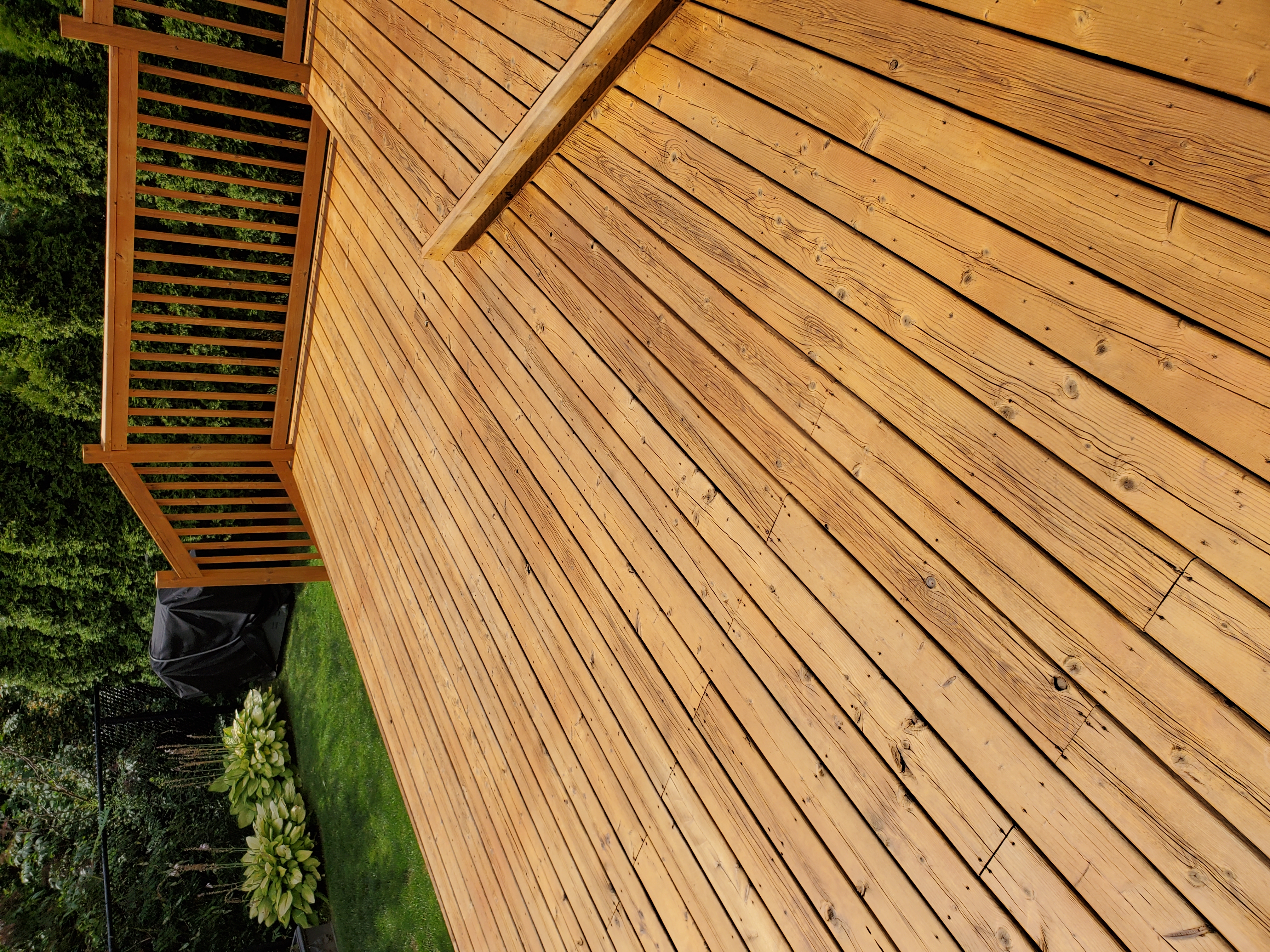
If your deck is looking weathered and you're planning to give it some attention this season, you'll run into the stain vs. paint question. It's one of the most common decisions GTA homeowners get wrong — often because the painter who quotes the job pushes paint, and the pressure washing company pushes stain, and neither explanation is fully objective.
Here's an honest breakdown of both options, their actual performance in Ontario's climate, and which is right for your situation.
How They Work Differently
Penetrating stain
A penetrating oil-based or water-based stain soaks into the wood fibres rather than forming a film on top. It colours and protects the wood from within. Because there's no surface film, there's nothing to peel — when it wears, it fades gradually and evenly. Reapplication is straightforward: clean the surface, let it dry, apply another coat.
Paint / solid stain (film-forming products)
Paint and solid-colour stain both form a film on top of the wood surface. They provide complete colour coverage, hiding the grain entirely. The film is initially more protective against UV and moisture — but when it fails, it fails dramatically. Water infiltrates beneath the film through cracks and end grain, the film loses adhesion, and you get peeling, bubbling, and flaking that looks far worse than a worn stain.
Performance in Ontario's Climate
Ontario's climate is genuinely harsh on exterior wood finishes. Freeze-thaw cycles, high summer UV, humid springs and wet falls all stress whatever finish you put on your deck. This is the critical context for the stain vs. paint decision.
Why paint struggles on decks in Ontario
A deck surface takes punishment that walls don't — foot traffic, furniture, wet leaves, and standing water. Paint film on a horizontal surface that gets walked on, rained on, and frozen takes far more abuse than paint on a vertical siding surface. In Ontario, painted decks typically start to peel within 2–4 years. Once peeling starts, the only proper fix is full stripping — grinding or sanding off all the old paint — before any new finish can be applied. That process is labour-intensive and expensive.
Why stain performs better on decks
Penetrating stain doesn't peel because it doesn't form a surface film. When it wears — typically 3–5 years on a deck surface in Ontario — it fades uniformly. Refreshing it requires cleaning and a new coat, not stripping. Over the lifetime of a deck, a stain maintenance program is significantly less expensive and less disruptive than a paint-and-strip cycle.
If your deck has been painted: You have two realistic options. Strip the paint completely (mechanically and/or chemically) and apply stain — the right long-term decision. Or repaint, accepting that you'll need to strip it eventually. Do not apply stain over paint — penetrating stains cannot penetrate a paint film and the result will be patchy and short-lived.
When Paint or Solid Stain Makes Sense
There are situations where a film-forming product is the right choice even on a deck:
- The wood is in poor condition: Heavily weathered, grey, or damaged wood that's past the point of looking good with a semi-transparent stain can be hidden with a solid colour. This buys time without replacing boards.
- You're selling the home soon: A freshly painted deck looks clean and bright for showings. If you're selling within 1–2 years, the eventual peeling problem becomes someone else's issue.
- Railings and trim: Paint on vertical railing components performs significantly better than on horizontal decking surfaces. Many homeowners stain the decking and paint the posts and rails — a reasonable hybrid approach.
Our Recommendation for GTA Decks
For virtually every GTA homeowner planning to stay in their home for more than a few years: penetrating oil-based stain, two coats, applied to a properly pressure-washed and dried surface. This is what we use on every restoration job at 416Marvel — not because it's the easiest to sell, but because it's what holds up and doesn't create expensive problems down the road.
The specific product matters too. Premium exterior penetrating stains like Cabot, TWP, or Armstrong Clark penetrate deeper, last longer, and look better than hardware-store brands. The labour cost of applying them is the same — the material cost difference on a typical deck is $50–$150. It's not where you want to save money.
Deck Restoration & Staining
Across the GTA
We pressure wash, prep, and apply two coats of premium penetrating exterior stain. No paint, no shortcuts. Free on-site quotes across Toronto, Vaughan, Mississauga, Brampton, Richmond Hill and the GTA.
Request a Free Quote ↗ Call (416) 709-0909